Showing posts with label Literature. Show all posts

Monday, November 05, 2007

A DAMNED Good Review!

I found this review and, as a certifiable superannuated hippie I say unto you, I have gazed upon these words and they are true.

This book was the cause of far too many saccharine overdoses amongst my brothers and sisters in motley, and, as a friend once opined, the presentation of this volume to a loved one oft signaled the end of the relationship.

Friday, August 24, 2007

The Liberated Library

You might think that I am a bibliomaniac, but that is far from the truth. I am not manic about books. I buy them, sell them, trade them and lend them. I certainly will admit to being a bibliophile, a lover of books.

I have always been a voracious reader, ready to be immersed in the new worlds or alternate visions that books provide. As a writer, I understand that words are a form of power that can be used and abused. So when I find a book that I like, I feel that it imparts some of its power to me. My shelves of books are like my armor, Quixotic armor, rusty and dented, but protective nonetheless.

So disposing of a large part of my library is like stripping away a protective shell, laying myself bare to a world that is not as neatly ordered as my volumes. Like a hermit crab abandoning its shell and trailing its soft abdomen as it searches for another, I feel vulnerable. Unlike J. Alfred Prufrock, I don't particularly want to be a pair of ragged claws, Scuttling across the floors of silent seas.

I will also admit to being a collector. The books that I collect are old, but not necessarily expensive. The most I have ever paid for the books that I collect is about $50, and that one was special since it had the bookplate of its previous owner in it; the previous owner being Harpo Marx. (Which reminds me that his brother Groucho once said that, "Outside of a dog, a book is man's best friend. Inside of a dog it's too dark too read."

Some that I own I bought for a few dollars at second-hand bookshops only to find later that they were worth hundreds of dollars. Many of these, although dear to me, will be finding new homes.

I am going to think out loud, so to speak, about the process of culling.

My collection consists of quarto-sized books primarily published by The Bodley Head at Oxford, England or Dodd Meade in the US. They are beautifully illustrated fantasies by Cabell, Anatole France and others. They are staying with me, as are the complete sets of Sir Richard Burton's translation of "A Thousand Nights and A Night" and Fraser's "The Golden Bough".

Much of the poetry will go. The books on technical writing, semiotics, linguistics and much of the science and math will descend into the cardboard purgatory with most of the religion and philosophy.

The reference books stay. So what if I have three rhyming dictionaries ... they stay. The books on colonial history, agriculture and architecture stay.

Most of the novels will go except for those that would be nearly impossible to replace. Probably half the books on design will also find new homes.

The easiest to dispose of and the first to be packed will be the collection of books that I have written. It's not as horrifying as it sounds. I spent many years as a technical writer and wrote hundreds of software manuals, marketing guides, reference books, and contributed papers to many periodicals and proceedings. All of them are outdated and although I am proud of the work, they are now meaningless.

Ah me ... I know that I am doing the logical thing, but my heart disagrees with my head. Logic is like the the curate and the barber in Don Quixote, sorting and consigning the mad knight's books to the fire as he lies sleeping.

"That night the housekeeper burned to ashes all the books that were in the yard and in the whole house; and some must have been consumed that deserved preservation in everlasting archives, but their fate and the laziness of the examiner did not permit it, and so in them was verified the proverb that the innocent suffer for the guilty.

One of the remedies which the curate and the barber immediately applied to their friend's disorder was to wall up and plaster the room where the books (had been), so that when he got up he should not find them (possibly the cause being removed the effect might cease), and they might say that a magician had carried them off, room and all; and this was done with all despatch. Two days later Don Quixote got up, and the first thing he did was to go and look at his books, and not finding the room where he had left it, he wandered from side to side looking for it. He came to the place where the door used to be, and tried it with his hands, and turned and twisted his eyes in every direction without saying a word; but after a good while he asked his housekeeper whereabouts was the room that held his books.

The housekeeper, who had been already well instructed in what she was to answer, said, 'What room or what nothing is it that your worship is looking for? There are neither room nor books in this house now, for the devil himself has carried all away.'"

But this is no destruction. My wife has no kindling at hand. There will be no garden conflagration ... except, perhaps for the trivial instructions I have penned. Although, if they are to burn, it will be by my hand. I will not make a Lady Burton out of her; putting her husband's manuscripts (no matter how trivial) to the torch.

No, these orphan books shall go to good homes, shall be adopted by bibliophiles more settled and secure. I send them off with a quote from Richard LeGallienne:

"Thus shall you live upon warm shelves again,
And 'neath an evening lamp your pages glow."

Thursday, August 23, 2007

The Bookman's Melancholy

I am in the process of decimating my library. Actually, it's worse than that. I have had to set myself the goal of reducing my collection of books by at least two thirds.

This is a painful process for someone whose life has always centered around the written word, both his own and others. Don't misunderstand me, I appreciate a good movie, and although I seldom watch television these days, I enjoy some of it quite a bit.

But I grew up with books, and they are my first love. My parents say that I first started to read on my own when I was three-years-old. By the time I was in 5th grade, my bedroom was filled with bookshelves from wall to wall. As a freshman in high school, I was the only person other than the librarians to have a stack pass to the city library. (They told me that it was self-defense since I read so much and such varied subjects that it was easier to let me get my own books than for them to be constantly searching out yet another obscure book.)

The size of my personal library peaked many years ago at about 10,000 or so volumes. Since then I have tried to impose some discipline. Until then, any book that I liked, or thought that I might like better in the future, or that I thought I might need for research, etc. could easily find itself a home on my shelves. Well actually it would have had to be a book that was intolerably bad in some way not to achieve at least a temporary adoption.

These days, I try hard to be diligent about culling but, I probably have over one thousand books in this room alone, and another 500 or so scattered elsewhere throughout the house. Several of my bookshelves are stacked two layers deep.

People don't read as much as they used to, or so I am told. I guess that must be true since even the well-read among my friends are startled by the volume of books on the walls of my study. I must be out-of-date.

I have mentioned before, when in a listing frame of mind, some of the books that live here with me, so I will not revisit them all. But to return to the subject of this blog, I would like to examine here the melancholia of a bookman in the process of divorcing his companions.

Here is, as the King of Siam would put it, a puzzlement. I have three copies of Rabelais' works. Each contains the same text translated by the same translator, yet each has its own unique charm. Which of them shall be sent away, expelled from its place on the shelf? How am I to make a choice?

The first cut is easy. One of the copies is a paperback used only for reading to save wear and tear on the other two. With only a small pang I place the tattered Penguin paperback into the box to be joined later by other outcasts.

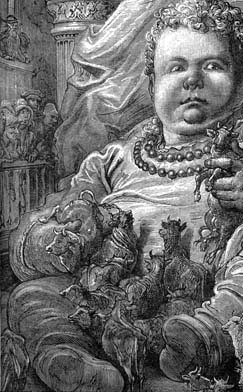
But the second choice is hard. The two hardcover books sit next to me as I write, waiting to learn their fate. The smaller is covered in brown cloth with goldleaf title on the spine and an illustration in gold on the front cover. Published by Chatto and Windus in 1879, it contains "numerous" illustrations by the great Gustave Dore. Illustrations even more delightful than those he made for Dante's "Divine Comedy". They are wicked, bawdy, and powerful.

Dore's illustration of baby Gargantua

... and yet ...

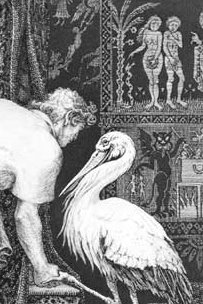
The book with the red cover has no date on it, but I know that it was published in 1927. It contains the same text, but this one was illustrated by Frank C Pape, an artist now mostly forgotten except by a few fanatics (in whose company I eagerly count myself). He is an illustrator whose delightfully vicious sense of humor was so perfect that James Branch Cabell once wrote him a letter apologizing that his text was no match for Pape's illustrations.

Detail of a Pape illustration from Cabell's "Figures of Earth"

How do I choose between them?

The simple answer is ... I cannot. I place the two books back on the shelf.

My wife comes in to see how my task is progressing. She looks in the box at the single paperback, laughs and shakes her head. She pats me on the shoulder, kisses my on the ear and tells me to keep up the good work.

Thursday, June 28, 2007

An Editorial Limerick

The editor stood there and blinked
At the author whose lips were all tinct-
ured with black.
Then, taken aback,
Said, "That's not what I meant by succinct."


Tuesday, July 12, 2005

To Mrs. Professor in Defense of My Cat's Honor and Not Only

A triple treat for you to make up for my absence. First - The title links to an excellent poem by Czeslaw Milosz. I could say more, but the notes below the poem will suffice. Second - Here are a lot more of his poems. Third - Let me tell you how I learned about him. A few months ago, someone wrote to tell me about "The Wondering Minstrels," a poetry email service that sends a poem nearly every day. The poems are accompanied by personal commentaries, critical analyses etc. The archive website lets readers comment. You can also subscribe from there.

Saturday, January 29, 2005

Pish on posh

This word's apocryphal acronymic association is absolutely absurd. The story is that "POSH", an acronym for Port Out, Starboard Home, was printed on 1st Class tickets for travel between England and India issued by the Peninsular & Oriental Steam Navigation Company. The original folk etymology suggested that the port side on the trip out would have the coolest cabins ... a curious theory since it assumes that the microclimate of a ship is capable of providing a significant temperature differential. It does not take into account the position of the sun, the direction of the wind, or the fact that as the ship sails South to Cape Horn the port side will face East on the other side of the cape, sailing North the port side faces West. If the trip is through the Suez Canal, the time of year is more likely to be a temperature factor. This being the case an alternate theory was concocted. This suggested that the port side would always be in view of the shore and therefore the scenery would be better. But ships, especially large passenger ships do not hug the coast. There are too many possibilities for disaster from weather or shallows. Putting the death blow to this story is the fact that no tickets with POSH on them have ever been found, and the company records show no evidence of the phrase. Merriam Webster puts the earliest publication of the acronym story in the London Times Literary Supplement of October 17, 1935. But "posh," meaning a dandy, dates back to 1867. Some think it derives from a Romani word meaning half (used in monetary terms). Others, including Partridge, think it may be a contraction of polish. To spin this etymological circus out yet further, I could make a case for some other derivations as well. Posh -- from pasha a middle-eastern title for a ruler. Folklorically, pashas lived in great splendor and luxury. Luxurious items were sometimes described as "fit for a pasha." The phrase degraded and shortened to "pash" or "posh". Posh -- a variant of pashe or paishe which itself is a shortened variant of "passion". Posh -- a term used to indicate the luxurious decorations and vestments used in the church at "Pasch" or "Pasche" meaning Easter (Paschal season).

Wednesday, April 30, 2003

The Original Anatomy

It occurs to me that not everyone knows of Robert Burton's book. It is not easy reading. I keep it on my nightstand for those times, more frequent these days, when I cannot sleep. This is not to say that he is a soporific, rather that he is a writer to whom you must pay attention and give him hours of concentrated effort.

Burton had a classical education from which he drew quotes and references in abundance. My classical education is drawn primarily from his. To use his erudition in my essays would be redundant. Those quotes I use will be contemporary, and I will leave the classics to Burton, who knew them better.

My intent is not to parrot his work, but search for an escape from my melancholy in somewhat the same way. However, I am more engaged in externals than he was. I am married with children. I have not the time provided him as a scholar and a clergyman to sit and muse, observing life from a distance.

All the tools I have are my autodidactic tendencies, my library, my senses and my wit (what there is of it). If I write in an archaic style it is because I love writing. If I think and declaim curious ideas, it is because I think in curious pathways. If you do not enjoy my essays, you are free to ignore them. They are not written for you. They are written for me.

I am tired and I am sad. I look at politics and I see children playing "king of the castle." I look at religion and I think of Aesop's fable of the dog in the manger. I am weary of those who know they are right, and I can find no trace of those who know that they may not be.

I am disturbed at the ease with which people stop thinking in order to follow a leader. I am disgusted by the cant of art critics who praise for fear that condemnation will show that they know nothing of their subject.

Discussion has been abolished in favor of certainty. There is no conversation, there is no thought. The new mantra is, "if you do not think as I do, you are wrong." I have no problem with those who are passionate about their ideas. I am disheartened by those who think that there should be no opposition.

It is so easy to think that you are the only one who knows the truth. It is even easier to think that the person you idealize is the only one who knows it. Blind faith allows no argument. It is too easy to take refuge in the evangelical argument, "If you do not believe as I have been told to, you are damned."

I place the blame on the complexities of modern society. There is so much to know, so much to understand. Blind faith removes the complexity. It is too easy to dismiss other world views. It is too hard to think for ones self. It is so easy to discard logic. Logic is messy, faith is easy.