Friday, September 22, 2017
The joy of blustery days
The edge of Jose swirls warm and damp through the trees here in New England, whipping the top branches into frenetic dancing while the more sedate lower limbs sway quietly. I am glad that the storm did not hit directly, but I am also glad that the bluster of weather outside gives me an excuse to sit and work. I was once a technical writer and my work consisted almost entirely of sitting in front of a screen, much as I am right now, testing software, finding my way through processes, and writing down the steps and explanation that others could use to make the program work properly. There is an art and skill that is unique to the field and a took a great deal of pride knowing that I was good at it and that those who worked for me were even better. I'm sure many who knew me then would be bemused by what I'm working on now.When I'm done posting this, I'll shove my computer to the back of the big oak library table that is my work space, turn on the speakers and as I listen to Silly Wizard, The Chieftains, De Dannan, and Iona, I'll set up my bench hook, untie my tool roll and continue work on a basswood bas-relief of a sparrow perched on a leafy twig. My knives, chisels and gouges are sharp, the mallet that I carved out of a holly trunk will be at my right all of the sharp stuff to the left ... and that's me gone for the next few hours.I'm not a very good carver (a fact underscored by the failed figures of foxes, birds, and buddhas that perch here and there on my bookshelves) but I'm trying and it's good for my head. As an added bonus my grandchildren seem delighted to watch the progress and are wonderfully forgiving of my errors.I think today I'll start with Silly Wizard's "If I were a blackbird".


Monday, September 11, 2017
Redivivus
Well it seems that i have taken a four year sabbatical from blogging here. Prodded by a dear online friend I will start being more diligent.I have started other blogs but, as is usual for one of my distractible persuasion, have let them fall into disuse. I shall therefore combine any useful or interesting stuff into either this site or my autobiographical IDKIIRC site, and retire the others.I have received several messages about Meera Collier's reposting of my 9/11 piece, and I thank you for your comments.
Wednesday, September 04, 2013
The Pleasures of Anglophilia
When I was in high school (several millenia ago), a cute exchange student appeared one fall. Her name was Penelope and she was English with blond straight hair, green eyes and a fantastic figure. She dressed modestly, unlike most of her classmates who were typical Harvard Square hooligans. I, for example, commonly wore black jeans, engineer boots, black turtleneck and a blue Oxford cloth button-down shirt. The engineer boots were my personal modification to the intellectual thug uniform.
At that time, Rindge Technical School was across a small park from Cambridge High and Latin. Sitting in the middle of the park was the Cambridge Public Library. Although the true thugs from Rindge (things are often black and white to teenagers) we CHLS students rarely ventured past the library into terra incognita.
One day I approached a small hormone addled mob of boys in this park. A horde of hesitantly hovering bees humming around the flower that was Penny. The difference between them and me was that I was meeting her there to take her for a walk. Desperately trying to look cool and unconcerned the boys chatted to each other about how they did in the swim meet, or the riot in the lunch room last week.
I stood back a little waiting and admiring how her yellow dress, which was far too frilly for the current styles, set off her hair and eyes. Penny noticed me just as one poor guy, in a desperate bid to attract attention through sympathy, started to complain about the unfair marking of the last history test. He got a response from Penny, but not what he was expecting. After listening to him moan and groan for a minute or two she said offhandedly,
"Oh for God's sake. Keep your pecker up."
The sudden silence was amazing, as was the rising blush on the faces of the other boys as they slithered off in disbelief.
"What did I say?" she asked me. An anglophile even then, I knew what that what she'd said was "keep a stiff upper lip" or as some would say these days "man-up". I very diplomatically hinted at possible other interpretations. She laughed.
"What a bunch of wankers," she said.
I agreed, and we walked down to the Charles River to ... ummm ... discuss it in more detail.
At that time, Rindge Technical School was across a small park from Cambridge High and Latin. Sitting in the middle of the park was the Cambridge Public Library. Although the true thugs from Rindge (things are often black and white to teenagers) we CHLS students rarely ventured past the library into terra incognita.
One day I approached a small hormone addled mob of boys in this park. A horde of hesitantly hovering bees humming around the flower that was Penny. The difference between them and me was that I was meeting her there to take her for a walk. Desperately trying to look cool and unconcerned the boys chatted to each other about how they did in the swim meet, or the riot in the lunch room last week.
I stood back a little waiting and admiring how her yellow dress, which was far too frilly for the current styles, set off her hair and eyes. Penny noticed me just as one poor guy, in a desperate bid to attract attention through sympathy, started to complain about the unfair marking of the last history test. He got a response from Penny, but not what he was expecting. After listening to him moan and groan for a minute or two she said offhandedly,
"Oh for God's sake. Keep your pecker up."
The sudden silence was amazing, as was the rising blush on the faces of the other boys as they slithered off in disbelief.
"What did I say?" she asked me. An anglophile even then, I knew what that what she'd said was "keep a stiff upper lip" or as some would say these days "man-up". I very diplomatically hinted at possible other interpretations. She laughed.
"What a bunch of wankers," she said.
I agreed, and we walked down to the Charles River to ... ummm ... discuss it in more detail.
Monday, September 02, 2013
The Leather Nun
I was in Milwaukee working for the federal government from 1972-76. My salary was so low that my family would have qualified for food stamps except that, at the time, government employees were excluded. I also couldn't afford a good place to live. So I ended up in a cross between a tar paper shack and four unit apartment building on Pulaski St., with a hooker in the other second floor apartment a trash collector directly below us and a family of Gypsy women in the fourth unit.
My wife found this unwholesome, so I took out a loan and moved us out to West Allis to an apartment complex that looked like a cross between a minimum security prison and a strip mall. Suddenly, shortly after our second child was born, I came home to find her packing. She was moving back to the East coast with the kids. She was leaving immediately.
After terminating the lease, I moved to a tiny apartment (I hadn't known that Murphy beds still existed) a few blocks from my office on North Prospect Street near Lake Michigan. I moved in with a couple of stacks of books, a couple of changes of clothing, some discount willow pattern china, a wok and a rice pot.
I wasn't done with my marriage, and I've always been a little too honorable for my own good. So instead of searching for love, I just searched for companionship. I just needed some good company. One of the people I found was Franz. On the weekends I earned some extra spending money by doing tarot readings (I used the now out-of-print Hurley-Horler deck if you're interested) and Franz owned an occult book shop, where he let me ply my trade.
Franz also studied the art of saber fencing, and introduced me to live war-gaming with BB guns goggles and heavy clothing in the maze-like tunnels and passages under the two or three blocks surrounding the store. This may seem somewhat advanced for 1973 or 74, but remember this is the city that hosts The Safe House bar.
One day Franz introduced an attractive lady in her mid 20s. She was about 5'6" and slender with short curly blond hair and wore a white cotton shirt tucked into Levis and engineer boots. I couldn't help but notice that she wasn't wearing a bra ... probably because her shirt was unbuttoned halfway to her belt buckle.
"This is The Leather Nun," he informed me and laughed as my expression must have shown a bit of disbelief. "You'll figure it out," he chortled as he walked away.
"Did you want a reading?" I asked, confused.
"No, I need a date."
"I'm sorry, I'm a married man," I explained, somewhat ruefully. As I said, she was quite attractive.
"Unavailable," she said, "but without any current family duties."
I shot Franz a glance but he was feigning innocence and pretending to arrange the shelves.
"Well ... yes?"
"Then you'll be perfect," she said. "Mose Allison is at the Blue River Café tonight, my date stood me up and I don't feel like getting hit on by a bunch of middle-aged jazz nuts."
"So you're looking for a stand-in."
"Yes ... You do know who Mose Allison is?"
"Of course. So this isn't actually a date?"
"No."
I didn't get to be a good tarot reader by being obtuse.
"So I suppose your date doesn't like jazz, and she wanted to do something else."
She laughed. "Franz said you were fast."
I grinned back at her. "So the idea is, that we're two music lovers who pose no romantic threat to each other."
"That's it."
"I'm not sure that I'll be able to fulfill that role if you don't tuck that away." I nodded at the pretty pink nipple that was poking out.
"What this?" She hauled her breast out and examined it as if she'd never noticed it before. "Well if it bothers you ... " She tucked it back in and fastened up one or two buttons
"Well," I said, "as it happens, I've got stage-side seats for tonight, but apparently someone ... " I turned and smirked at Franz, "will have to go home after work."
Franz lumbered forward and grabbed us both in a bear hug.
"Good. I can't stand that weak-ass espresso at Blue River anyway. You kids play nice now."
That was the beginning. Tina (as I discovered her name to be) and I had similarly eclectic tastes in music and art, and we spent a lot of time together. I met her partner once, a darkly sulky Joan Baez type who dismissed me as her partner's "pet castrato". She claimed to be an ethnomusicologist and spent altogether too much time explaining why our tastes in music were degraded and how much more expressive the grunts of some obscure Amazon tribe were than any "composed" pop garbage. I forgot about Franz's odd introduction.
One weekend we were going to a performance by John Fahey and I suggested that we meet for dinner first at this decent Italian place on East Brady Street. She said that she'd meet me there. She asked me to try to get a seat by the window.
About five minutes after I had been seated. I was looking at the menu when the restaurant went quiet ... very, very quiet. I looked up and saw Tina pull back the chair across from me and sit down. I did mention that this was a VERY Italian place. Most of the patrons were speaking either Italian or heavily accented English. Italian grandmothers in black, Italian mammas with their bambini, Italian construction workers with biceps like fuckin eggplants.
Tina was wearing a nun's habit.
Let me be absolutely clear on this.
Tina was wearing a nun's habit.
She had added a leather under bust corset which she was wearing over the habit. The nun's habit was sheer and it was quite obvious that she wasn't wearing anything underneath.
She sat down, pushed the Chianti bottle candlestick to the side, leaned across the small table with its red and white checks and with great gusto gave me an unaccustomed, deep and sloppy kiss. then she sat back.
I looked around the room. Forks were frozen in midair, pasta of various shapes quivered on the tines dripping sauce on the tablecloths. One man was petrified and, as I watched, the cheese and tomato of the slice of pizza he held, slowly eased itself over the crust and dropped to his lap.
I looked back at Tina. She smiled at me sweetly. I had about 18 nano-seconds of pleasure before my instinct for self-preservation kicked in. I leapt to my feet, grabbed her by the arm, and rushed her to the door.
I could hear the room doing a collective dinosaur take as she reached back and gave my butt a squeeze. I heard chairs being pushed back and silverware hitting the floor as the door slammed shut behind us.
I rushed her around the corner and into a side street. As we waited for the shouting to die down, I slipped my jacket over her shoulders.
"A little underdressed tonight, Tina."
"I just needed some attention."
"Well you certainly got it."
We stifled our giggles and she kissed me again.
"Thanks," she said. "That was fun and you're a sweety for putting up with me."
"Just one thing, Tina," I said.
"What's that?"
"Please make sure that you never warn me when you are going to pull one of these stunts."
"I promise."
I took her home. She changed into a denim skirt and Indian print blouse (still sheer, but not as mind-numbingly so). Then we went to listen to John Fahey be rude to us as he broke strings and retuned them over and over.
My wife found this unwholesome, so I took out a loan and moved us out to West Allis to an apartment complex that looked like a cross between a minimum security prison and a strip mall. Suddenly, shortly after our second child was born, I came home to find her packing. She was moving back to the East coast with the kids. She was leaving immediately.
After terminating the lease, I moved to a tiny apartment (I hadn't known that Murphy beds still existed) a few blocks from my office on North Prospect Street near Lake Michigan. I moved in with a couple of stacks of books, a couple of changes of clothing, some discount willow pattern china, a wok and a rice pot.
I wasn't done with my marriage, and I've always been a little too honorable for my own good. So instead of searching for love, I just searched for companionship. I just needed some good company. One of the people I found was Franz. On the weekends I earned some extra spending money by doing tarot readings (I used the now out-of-print Hurley-Horler deck if you're interested) and Franz owned an occult book shop, where he let me ply my trade.
Franz also studied the art of saber fencing, and introduced me to live war-gaming with BB guns goggles and heavy clothing in the maze-like tunnels and passages under the two or three blocks surrounding the store. This may seem somewhat advanced for 1973 or 74, but remember this is the city that hosts The Safe House bar.
One day Franz introduced an attractive lady in her mid 20s. She was about 5'6" and slender with short curly blond hair and wore a white cotton shirt tucked into Levis and engineer boots. I couldn't help but notice that she wasn't wearing a bra ... probably because her shirt was unbuttoned halfway to her belt buckle.
"This is The Leather Nun," he informed me and laughed as my expression must have shown a bit of disbelief. "You'll figure it out," he chortled as he walked away.
"Did you want a reading?" I asked, confused.
"No, I need a date."
"I'm sorry, I'm a married man," I explained, somewhat ruefully. As I said, she was quite attractive.
"Unavailable," she said, "but without any current family duties."
I shot Franz a glance but he was feigning innocence and pretending to arrange the shelves.
"Well ... yes?"
"Then you'll be perfect," she said. "Mose Allison is at the Blue River Café tonight, my date stood me up and I don't feel like getting hit on by a bunch of middle-aged jazz nuts."
"So you're looking for a stand-in."
"Yes ... You do know who Mose Allison is?"
"Of course. So this isn't actually a date?"
"No."
I didn't get to be a good tarot reader by being obtuse.
"So I suppose your date doesn't like jazz, and she wanted to do something else."
She laughed. "Franz said you were fast."
I grinned back at her. "So the idea is, that we're two music lovers who pose no romantic threat to each other."
"That's it."
"I'm not sure that I'll be able to fulfill that role if you don't tuck that away." I nodded at the pretty pink nipple that was poking out.
"What this?" She hauled her breast out and examined it as if she'd never noticed it before. "Well if it bothers you ... " She tucked it back in and fastened up one or two buttons
"Well," I said, "as it happens, I've got stage-side seats for tonight, but apparently someone ... " I turned and smirked at Franz, "will have to go home after work."
Franz lumbered forward and grabbed us both in a bear hug.
"Good. I can't stand that weak-ass espresso at Blue River anyway. You kids play nice now."
That was the beginning. Tina (as I discovered her name to be) and I had similarly eclectic tastes in music and art, and we spent a lot of time together. I met her partner once, a darkly sulky Joan Baez type who dismissed me as her partner's "pet castrato". She claimed to be an ethnomusicologist and spent altogether too much time explaining why our tastes in music were degraded and how much more expressive the grunts of some obscure Amazon tribe were than any "composed" pop garbage. I forgot about Franz's odd introduction.
One weekend we were going to a performance by John Fahey and I suggested that we meet for dinner first at this decent Italian place on East Brady Street. She said that she'd meet me there. She asked me to try to get a seat by the window.
About five minutes after I had been seated. I was looking at the menu when the restaurant went quiet ... very, very quiet. I looked up and saw Tina pull back the chair across from me and sit down. I did mention that this was a VERY Italian place. Most of the patrons were speaking either Italian or heavily accented English. Italian grandmothers in black, Italian mammas with their bambini, Italian construction workers with biceps like fuckin eggplants.
Tina was wearing a nun's habit.
Let me be absolutely clear on this.
Tina was wearing a nun's habit.
She had added a leather under bust corset which she was wearing over the habit. The nun's habit was sheer and it was quite obvious that she wasn't wearing anything underneath.
She sat down, pushed the Chianti bottle candlestick to the side, leaned across the small table with its red and white checks and with great gusto gave me an unaccustomed, deep and sloppy kiss. then she sat back.
I looked around the room. Forks were frozen in midair, pasta of various shapes quivered on the tines dripping sauce on the tablecloths. One man was petrified and, as I watched, the cheese and tomato of the slice of pizza he held, slowly eased itself over the crust and dropped to his lap.
I looked back at Tina. She smiled at me sweetly. I had about 18 nano-seconds of pleasure before my instinct for self-preservation kicked in. I leapt to my feet, grabbed her by the arm, and rushed her to the door.
I could hear the room doing a collective dinosaur take as she reached back and gave my butt a squeeze. I heard chairs being pushed back and silverware hitting the floor as the door slammed shut behind us.
I rushed her around the corner and into a side street. As we waited for the shouting to die down, I slipped my jacket over her shoulders.
"A little underdressed tonight, Tina."
"I just needed some attention."
"Well you certainly got it."
We stifled our giggles and she kissed me again.
"Thanks," she said. "That was fun and you're a sweety for putting up with me."
"Just one thing, Tina," I said.
"What's that?"
"Please make sure that you never warn me when you are going to pull one of these stunts."
"I promise."
I took her home. She changed into a denim skirt and Indian print blouse (still sheer, but not as mind-numbingly so). Then we went to listen to John Fahey be rude to us as he broke strings and retuned them over and over.
Thursday, August 08, 2013
Art and writing
There is much in modern life to induce a state of melancholia. Much that Sir Robert saw has become more poignant and painful in the passing of the years. It could be said that though mankind has advanced in many ways it has regressed in many that make up the quality of our daily lives.
Many of these regressions are so entwined with our current understanding of "the way things are," others may superficially seem to benefit humanity and still others may seem like divine gifts promising better, more productive and peaceful lives.
But, as in all things, balances must be struck, easements and bargains must be made. Something may be given with one hand, but you may be sure that the other is extended for recompense. Though the price of a thing may seem to be merely money, far more may be expected. Other tenders accepted might be the quality of conversation, of intimacy, of sympathy, the blind acceptance of mass delusions, the appreciation of nature and of one's own humanity.
An artist working in digital media may seem to be more fortunate than his predecessors. No longer need he grind colors, inhale turpentine fumes, sharpen pencils, clean the charcoal from out his pores, stretch canvas and paper, clean brushes. No longer need he be poisoned by the very basis of his art and be driven mad by lead, cadmium, lapis lazuli and more. We may admire the work of mad artists but I would venture the thought that few of them took up a brush with the intent of descending, or rising, into insanity.
Beyond that, the digital artist has no need to mix paint to get the color needed, his brushstroke is not a hand skill developed from long practice but a selection from a menu. He need not despair that the proper paper is not available when he can duplicate its tooth and absorbancy with the press of a few keys on a keyboard. Waste is reduced since there are no failed attempts to crumple and discard. There is always plenty of ink, graphite, charcoal, and paint ready at hand for no additional cost.
On the whole it seems that working digitally provides many advantages to the artist. The question becomes what must she give up?
One thing that is lost is what I call the zen of preparation. That meditative period of time between her thought and the beginning of its realization. A computer screen lets her jump right into creation, which on the face of it, may seem to be a good thing. There is no searching the sofa cushions for enough change to buy a tube of Phthalo Blue, no stretching of canvas or paper, no gesso, no preparation of the palette and brushes or sharpening of the pencils, no time between inspiration and attempt. There is no time for her unconscious to rotate, palpate, and mold the thought into something more durable, more potent.
Another casualty is the contribution of the ground and the medium, the differences in the feel of applying ink to paper with a brush, or acrylics to a gessoed and stretched canvas, or water color to illustration board, or egg tempera to masonite. the flow of the medium onto the surface under the tip of a pen, the hairs of a brush, or the spring of a palette knife.This is a direct modification of physical entities and there is a feel, a resistance, an impetus that travels the nerves in a constant feedback loop as the artist senses the rightness of a line, a swirl, a dot in the nerve endings of her fingers, a positive sense that travels upstream to her brain to show that her hand and eye are in perfect coordination.
A physical painting, drawing or sculpture is unique. True, they can be forged, but it takes a great amount of effort for relatively little return. A digital work, however, is easily duplicated and reduplicated and rather than their signature and style for authentication, they needs must rely on watermarks and electronic tricks like steganography, that, and mutual promises from artist and owner not to publish any more. As time goes on artists will develop and use other devices to provide the sense of uniqueness, but their will always be a niggling suspicion at the back of the purchaser's mind.
The greatest loss is something that only certain types of people think about, mistakes. It is not just researchers, and scholars who treasure the missteps, the sketches, the cartoons that are created in the process of creation, they are the trials, the half-formed concepts, the discarded errors that tell the story of the genesis of a work. The tale told in the intermediate steps is often lost with a digital creator who, more often then not, will simply revise the original leaving no breadcrumbs for their most diligent admirers to follow.
Lest you think that digital artists are being unduly singled out, let me hasten to say that the same is true in the writing profession. In the basement of a library in New England there are ten steamer trunks filled with manuscripts, drafts, and revisions constituting the life work of a major poet. It will be rare for future scholars to find the same profusion of documented trial and error for writers working today.
I am not immune to criticism on this account. I sit typing this text into a text editor, correcting spelling and grammatical errors on the fly aided by some handy software and leaving little trace of the fact that, when typing, I often substitute "d" for "g" as I do when handwriting. Is this something that some, as yet unborn, scholars would find useful? I know not, and yet I hate to deprive them of their clues. Will they deduce the brand of spellcheck and grammar parser from a meta-database of linguistic red flags? Will they find traces of corrections in the data files and try to redefine my writing in terms of their assumptions as to what I had originally written. I know not. Occasionally, I even despair.
I will continue this investigation.
Sunday, June 02, 2013
Visitor
We have a little visitor to our garden and it's beginning to look like it might be moving in. The poppies have popped in incandescent colors, the peonies are muscling through the wax that covers the buds, and my wife, Dee, abashed by all the floral effort decided to water the flower beds.
As she did her impression of a rain cloud, apparently she surprised something that made a dash for the tall grass. At first she thought it was a snake but when she looked for it she found it was a small brown rabbit about 6 inches long and, after the dash, with all the animation of a statue.
It stayed stock-still in the long grass as we looked at it and my son, Avi, took some photographs. Dee's first instinct was, of course, to pick it up, cuddle it, find it a nice box and feed it carrots. She was persuaded to let it be overnight in hopes that a parent would retrieve it. This morning it was still there.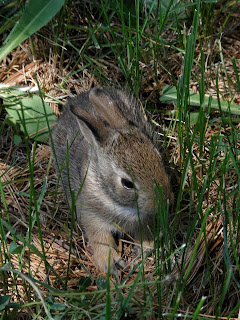
When my beloved earth-mother tried to save it, it proved to be less fearful of the rest of the world than of her, and made a dash for the flower bed again, disappearing amidst the poppies.
As for me, I'm torn between my appreciation of the cuteness of our visitor and the realization that now I know what happened to those lettuce plants that went missing. On the other hand, I just found out that chard is problematic for people who have had kidney stones, so maybe I should just let things take their course.
As she did her impression of a rain cloud, apparently she surprised something that made a dash for the tall grass. At first she thought it was a snake but when she looked for it she found it was a small brown rabbit about 6 inches long and, after the dash, with all the animation of a statue.
It stayed stock-still in the long grass as we looked at it and my son, Avi, took some photographs. Dee's first instinct was, of course, to pick it up, cuddle it, find it a nice box and feed it carrots. She was persuaded to let it be overnight in hopes that a parent would retrieve it. This morning it was still there.

When my beloved earth-mother tried to save it, it proved to be less fearful of the rest of the world than of her, and made a dash for the flower bed again, disappearing amidst the poppies.
As for me, I'm torn between my appreciation of the cuteness of our visitor and the realization that now I know what happened to those lettuce plants that went missing. On the other hand, I just found out that chard is problematic for people who have had kidney stones, so maybe I should just let things take their course.
Thursday, April 11, 2013
Spring has come at last ...
The temperature is nearly 50F, and it finally feels like spring today. There is only a tiny patch of snow left in the backyard and the grass is greening nicely.I wandered around to clean up. We lost one limb of the huge white pine in the northeast corner and a couple of dozen smaller branches. When I moved the deadfalls, I saw a small cluster of nascent lily-of-the valley plants close to the trunk.What a curious plant that is. One legend says that the flowers formed from the tears of the Virgin Mary, which sounds sweet and ethereal until you realize that the entire plant is highly toxic ... and what are we to make of that? Another curious thing about the flowers is that their odor is intensely attractive to mammalian sperm. This complicates the early spring delight of seeing new life so much that I decide to stop thinking lest I get a headache.The pile of dried twigs and branches in the garden is just about ready for burning. Today or tomorrow I'll go to the town police and fire station and get a permit. After my little bonfire is done I'll dig the ashes into the soil and plant tomatoes, basil, eggplant, chilis, zucchini, etc.The rhubarb plant owns an entire corner of the plot, and returns year after year. It is a mixed blessing. It is a beautiful plant, and tasty, but it is very high in oxalic acid and having had kidney stones once, I am determined to never have them again.
Birches with crows
In back of the drab cinderblock building, across a small pot-holed asphalt parking lot, there is a small grove of trees, maple saplings and a mass of vines and shrubbery. The skeletal look of the trees is made more intense by two old birch trees with bone white bark.The sky is gray, the overcast creates steely reflections in the puddles. I toss my gym bag in the back of the car and go sit on the hood to breathe and relax for a moment. I look for signs of life, but there is nothing to see. There is no green haze of budding leaves nor yellow mist of forsythia blossoms yet, just somewhat globular masses of leafless vines and bushes that look as if some gigantic cat has found a ball of rough yarn.The birches are grim. They are old and thick, but look like they're ready to die. Not only are they bony, they are broken. Thick limbs hang from splintered crotches, an ossuary of severed twigs and branches litter the ground beneath them.There is a sudden movement in the tree to the right. a black shadow detaches from one of the high branches, swooping down nearly to the ground then back up into the other tree where it lands ... knocking another shadow off the branch. The displaced crow freefalls momentarily then spreads its wings turns and swoops with a few unnecessary flourishes into the first tree, where it sits croaking softly, before launching itself back to knock its aggressor off the branch.The two crows continue this for some time. It's obviously play, since there's none of the harsh abrupt attack and calls that you would expect in a territorial contest. It's more a game of tag, or king-of-the-castle.After a while they move to trees that are further away, and shortly after that they disappear into a denser clump of trees in the distance. I get into my car and drive away.
Subscribe to:
Posts (Atom)